Preliminary state audit findings say $1.56 million in Daytona Beach permit fees paid for costs the law does not allow. The city says it has tightened its rules.
Florida’s Auditor General has sent Daytona Beach eight preliminary findings from a state audit of city spending. They cover building permit fee money, city purchasing cards and employee travel.
The findings are not the final audit report. Auditor General Sherrill F. Norman sent them to Mayor Derrick Henry in a letter dated Thursday, Nov. 19. The city must answer each finding in writing within 30 days of receiving the list.
The city published the letter Friday with a news release. It said it worked with the auditors throughout and had already tightened its controls.
Overview
- What it is: preliminary findings from the state’s operational audit of the city, covering October 2024 to February 2026. Four concern building permit fees and four concern purchasing cards and travel.
- The biggest figure: the auditors said $1,050,979 in permit fee money paid wages and benefits for work that was not building code enforcement.
- What the city says: it has moved those salaries to other funds, rewritten its card and travel policies and recovered most questioned expenses.
- What happens next: the city’s written response, then a final report and a hearing before the Legislature’s Joint Legislative Auditing Committee early next year.
Building permit fees
State law says money from building permit fees may be spent only on enforcing the Florida Building Code. That means plan reviews, inspections, permit processing and related work. The city keeps the money in its Permit and License Fund, which took in $14.6 million in permit fees during the audit period, the auditors said.
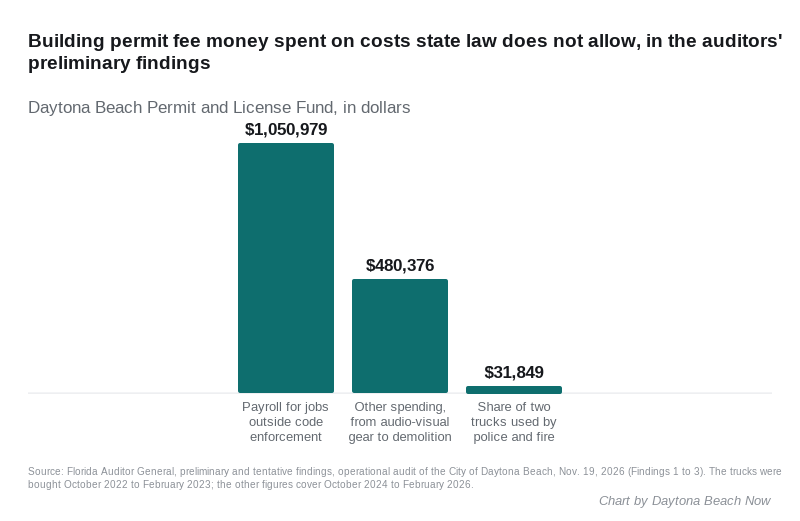
The auditors’ preliminary findings say the fund paid for costs the law does not allow:
- $1,050,979 in payroll. Eleven employees in eight jobs, such as a license officer and a rental program coordinator, did not mainly do code enforcement work, the auditors said. The city moved those salaries to other funds from July to October 2026, but had not paid back the earlier costs by September.
- $480,376 in other spending. It included $220,834 for audio-visual upgrades in City Hall and the commission chambers, $105,110 to demolish abandoned buildings and $4,680 to sponsor charity golf tournaments.
- $31,849 for two trucks. The fund bought 11 Ford F-150 trucks in 2022 and 2023 and assigned two to the police and fire departments, which used them partly for other work.
Those three figures add up to $1,563,204. Nine more of the F-150 trucks later went to other city departments, and those departments had not repaid the fund by September 2026, the auditors said. The findings do not put a value on those trucks.
The auditors also said the city’s method overstated how much permit money it was allowed to keep in reserve. The city’s own figures showed a surplus of about $10.9 million for the 2023-24 budget year and $5.1 million for 2024-25.
Purchasing cards and travel
City employees made 23,778 purchasing card transactions totaling $8 million during the audit period, the auditors said. Their findings in this area include:
- Cards left open. The city did not cancel the cards of 11 of 25 cardholders who left city jobs, the auditors said. They found no purchases made after those employees left.
- Unclear public purpose. In a sample of 30 card purchases, 10 totaling $15,387 broke city policy or lacked records showing their public purpose. One employee paid $441 more than the conference rate for a hotel and valet parking. The city recovered the $441 and barred the employee from city travel for a year.
- An old travel policy. The city’s travel rules dated from 1999 until a new policy took effect Feb. 1, 2026.
- Uneven enforcement. A city commissioner’s $775 purchase at a Daytona Beach pizza restaurant had only a receipt that did not list items, and no stated public purpose. The city manager approved it. The auditors said staff were “reluctant to compel the Commissioner to follow City P-card policies.” The same commissioner declined to repay $168 in trip costs the city questioned, according to the findings.
The findings do not name the commissioner. They also say the mayor and commissioners exempted themselves from the travel policy the city adopted in February. City staff told the auditors the mayor and commissioners would follow the policy, but did not say whether it would be formally changed, according to the findings.
What the city says
The city said it updated its purchasing card and travel policies in February 2026, before the audit began. “In nearly all instances, questionable expenses identified during the review were reimbursed and additional corrective actions were taken,” it said.
It said the permit fee findings involve a “decades-long operational practice.” It has changed how it splits payroll costs and added controls for vehicles moved between departments, it said.
“While these changes represent progress, we recognize that additional work remains,” the city said. City leaders will review each recommendation and deal with any outstanding financial adjustments.
What it means for you
- Building permit fees stay waived for now. To cut the surplus, the City Commission has waived building permit fees and extended the waiver through January 2027, the city and the auditors said. The commission also adopted a lower fee schedule in August.
- More money could go back into the permit fund. Any money the city pays back into the permit fund for the costs in the first three findings would make the surplus bigger, the auditors said. State law then requires the city to cut permit fees or refund them.
- The final report is public. After the city responds, the Auditor General will issue its final report and present it to the Joint Legislative Auditing Committee early next year. You can read the preliminary findings in full in the Auditor General’s letter to the mayor.
- To comment, you can speak at a City Commission meeting or contact your commissioner through who to call at City Hall.
Have your say