Four proposed maps would redraw Daytona Beach's six City Commission zones for 2028. A community meeting is Nov. 12; the commission votes Dec. 2. How to comment.
Daytona Beach has published four proposed maps that would redraw the six City Commission zones. The new lines would be used from the 2028 city election. Residents can comment at a community meeting at 6 p.m. Thursday, Nov. 12, at City Hall.
The city posted the plans and a timeline on its redistricting news page this week. The City Commission set that timeline Oct. 21 in Resolution No. 2026-347.
The timeline
- Thursday, Nov. 12, 6 p.m.: community meeting in Room 149B at City Hall, 301 S. Ridgewood Ave. The city’s redistricting consultant will explain the process and the four plans, and take questions and comments.
- Wednesday, Nov. 18: the consultant presents the plans to the City Commission. An ordinance setting the new zones gets its first reading.
- Wednesday, Dec. 2: public hearing on the ordinance. The city expects the commission to vote that night.
The current zones stay in place for the 2026 city election.
What the four plans show
Each plan splits the city into six zones of about 11,913 residents. That is the 71,478 people in the 2020 census figures the plans use, divided by six. The plans are posted as maps: Alternative 1, Alternative 2, Alternative 3 and Alternative 4.
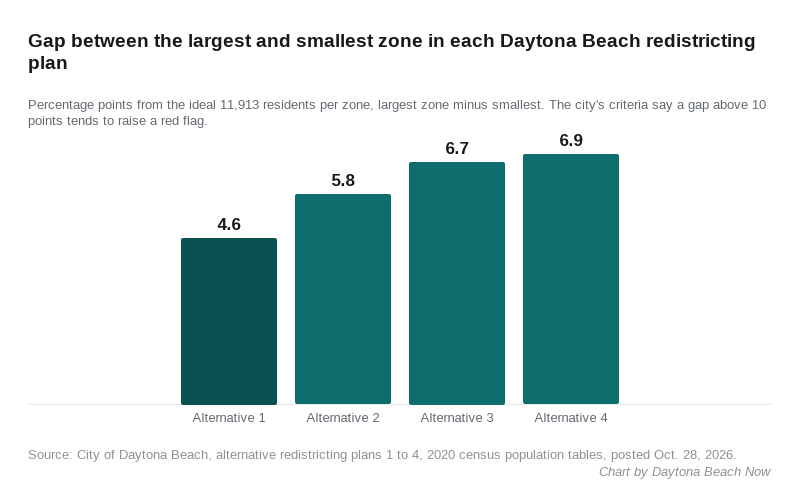
Each map carries a population table. We worked out the gap between each plan’s largest and smallest zone from those tables:
| Plan | Largest zone | Smallest zone | Gap |
|---|---|---|---|
| Alternative 1 | Zone 5, 12,118 (1.7% over) | Zone 6, 11,572 (2.9% under) | 4.6 points |
| Alternative 2 | Zone 3, 12,332 (3.5% over) | Zone 4, 11,638 (2.3% under) | 5.8 points |
| Alternative 3 | Zone 1, 12,353 (3.7% over) | Zone 5, 11,558 (3% under) | 6.7 points |
| Alternative 4 | Zone 1, 12,483 (4.8% over) | Zone 2, 11,662 (2.1% under) | 6.9 points |
Alternative 1 has the most even zones. In Alternative 1, Zone 1 has 12,113 residents, also 1.7% over the ideal.
The rules the maps follow
The city’s redistricting criteria say zones should be as close to equal in population as practicable. Population means residents, not registered voters.
The criteria say plans within 3% over or under the ideal size are acceptable goals. A gap of more than 10 points between the largest and smallest zone “tend[s] to raise a ‘red flag’ from an equal protection perspective,” the document says. All four plans are under that level. Each has at least one zone more than 2% from the ideal, and Alternatives 2, 3 and 4 each have one more than 3% over.
The criteria also say:
- zones should be compact and contiguous, and follow major roads, waterways or parks where possible
- existing boundaries can be kept where possible
- neighborhoods and homeowners associations should not be split where it can be avoided
- the home addresses of incumbents and candidates may not be considered
- race and ethnicity were not considered
Each map also shades the zones as they were drawn after the 2010 census, by Ordinance No. 12-23, so residents can compare.
Why the city is redrawing now
The City Commission adopted the current zones in Ordinance No. 2025-370 on Oct. 1, 2025. On Oct. 14, 2025, the group Vote! and several individual plaintiffs sued the city in federal court over that map, the city’s page says. The city says the lawsuit is ongoing.
What it means for you
- Find your zone on each plan. The four maps are online, and paper copies are in the City Commission lobby on the second floor of City Hall during business hours through Dec. 2.
- Say what you think in person at the Nov. 12 community meeting, or at the Nov. 18 and Dec. 2 commission meetings.
- Or write to the City Clerk at Clerk@DaytonaBeach.gov. Comments that arrive at least 24 hours before a commission meeting go to commissioners in advance. The city says emailed comments are not automatically read into the official record. Under Florida law, emails to the city are public records, including your address.
- Need an accommodation? Call the City Clerk’s Office at 386-671-8023 at least 72 hours before a meeting. Relay users can dial 711.
Our voting guide covers the Nov. 3 general election, and who to call at City Hall lists the commission’s contacts.
Have your say