A charter amendment would bar the city from using reclaimed blackwater for drinking water or aquifer injection. Here is the ballot wording and what staff warned.
Daytona Beach voters will decide Nov. 3 whether to write a ban on reclaimed blackwater into the City Charter. The amendment would bar the city from using it as a source for drinking water or for injection into the aquifer.
The City Commission voted in March to put the question on the ballot, the city said in a news release Oct. 21. Only voters who live in the city decide it.
The ballot question
The ballot title is “Limitation on reclaimed blackwater use by the City of Daytona Beach’s water utility system.” The question reads:
Shall the Charter of the City of Daytona Beach be amended to prohibit the City from approving the use by its water utility of reclaimed blackwater as a direct source water for either an underground injection well into the aquifer or into the City’s potable public water system?
That wording is set out in the ordinance the commission took up for final reading March 18. It would add a new Section 50 to the charter.
What a yes or no vote means
According to the city’s release:
- Yes adds the restrictions to the charter.
- No leaves them out. Any future use would stay subject to applicable laws, regulations and city approvals.
The city’s existing reclaimed water program for irrigation and other nondrinking uses would continue, the release says.
If the amendment passes, it takes effect once the vote is certified, the ordinance says. The commission would then have to pass a second ordinance to put it into the City Code.
What blackwater is
Florida law defines blackwater as the “part of domestic sewage carried off by toilets, urinals, and kitchen drains.” The city’s Utilities Department quoted that definition in a Feb. 26 memo to the city manager and city attorney.
The city treats wastewater from more than 100,000 customers. They are in Daytona Beach, South Daytona, about six miles south, and parts of unincorporated Volusia County. Both of its water reclamation plants meet advanced treatment standards, the memo says.
In staff’s view, the treated water “no longer contains ‘blackwater’ but instead meets the definitions of reclaimed water.”
Where the reclaimed water goes now
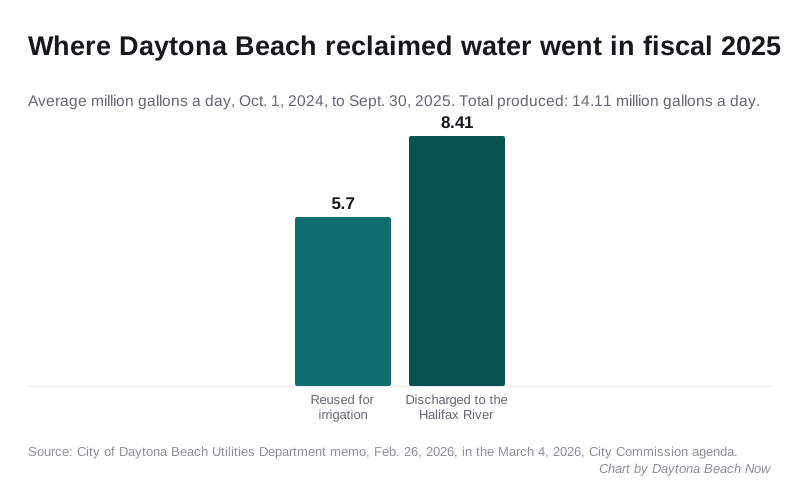
The city produced an average of 14.11 million gallons of reclaimed water a day in the 2025 fiscal year, the memo says. About 40% of it was reused for irrigation. The other 60% went into the Halifax River.
Users of the irrigation water include:
- homes and businesses in the reclaimed water service area
- the LPGA, Municipal and Pelican Bay North golf courses
- parts of Embry-Riddle Aeronautical University and Daytona State College
- Bennett Swamp, for wetland rehydration
What city staff told the commission
A 2021 state law, Senate Bill 64, requires utilities to end “nonbeneficial” discharges to surface water by Jan. 1, 2032. The memo says the city’s discharges to the Halifax River count as nonbeneficial. By then, the city will need a beneficial use for about 8 million more gallons a day.
In September 2025 the commission approved a study of the options by Carollo Engineers, at a cost of up to $209,113.98, under Resolution 2025-367. Three of the options under study involve injecting reclaimed water underground, the memo says. The amendment could rule them out.
“Should an underground injection well be found to be highly cost-effective, the inability to pursue such an option could lead to the need for a significant rate increase,” Deputy Utilities Director Eric Smith wrote.
The memo also says staff “is in no way seeking to undermine” the commission’s authority to call a referendum. Underground injection is regulated by the Florida Department of Environmental Protection under the federal Safe Drinking Water Act.
What it means for you
- If you live in the city, the question is on your ballot. Volusia County early voting runs through Saturday, Oct. 31, from 8 a.m. to 6 p.m., the Supervisor of Elections says.
- On Election Day, Tuesday, Nov. 3, vote at your assigned polling place. Our voting page explains how to find it.
- If you are a city water or sewer customer, staff say the choice could affect future rates. The engineering study’s cost estimates have not been published yet.
- If you use reclaimed water for irrigation, the city said that program would continue.
Have your say